
Vinyl plank vs tile
Which hard surface should replace the carpet, scored for El Paso conditions.
Read moreShort version: yes, all of it, every time. But the useful part of this question is not whether — it is what actually comes out, what we usually find underneath an El Paso slab, and what that discovery does to your quote.
Hablamos Español
The short answer
Yes, always. Vinyl plank cannot be installed over carpet of any kind. A click-lock plank floor needs a firm, flat substrate; carpet and pad compress under every footstep, and that flex works the locking edges apart until the seams fail. Removing carpet is step one on every job of this type, without exception.
What is worth talking about is everything else that comes out with it, and what the slab underneath looks like once it is exposed. That is where the surprises live, and it is the reason we do not give firm prices until the carpet is up or at least peeled back in a corner.
What comes out
The staples are the part homeowners underestimate. A single 12×12 bedroom can hold three or four hundred of them, and a staple standing 1/16 of an inch proud of a slab becomes a visible high spot under a plank floor. Under tile it becomes a void in the thinset. There is no way around pulling every one.
On an El Paso slab the tack strip is usually fixed with hardened concrete nails rather than staples. Pulling it leaves a line of small holes and occasional spalled edges along every wall, which get patched before anything goes down. None of this is difficult work. It is just work, and it needs to be in the quote as a scope item rather than assumed.
What is underneath
| Where | What we usually find | What it means for the new floor |
|---|---|---|
| East side, 1980s–2000s tract | Bare slab, sometimes paint overspray or mud | Straightforward. Scrape, patch, check flatness, install |
| Horizon City and far East, newer | Young slab, sometimes still settling | Check for shrinkage cracks and flatness before large-format tile |
| Northeast, post-war | Older slab, often uneven, occasional 9×9 vinyl tile | Levelling likely. Treat 9×9 tile as possible asbestos |
| Central, Sunset Heights, Kern Place | Sometimes original wood on a raised subfloor | Worth stopping to look before covering it permanently |
| Upper and Lower Valley | Slab on low river ground, occasional moisture staining | Test slab moisture before choosing an adhesive-bonded floor |
| Any era, over a garage conversion | Unsealed or poorly finished slab | Almost always needs levelling and a moisture check |
Patterns from our own work across the metro. Every house still gets checked individually.
In the older central neighbourhoods, removing carpet occasionally reveals original hardwood on a raised subfloor. It is usually filthy, often stained around the tack strip line, and frequently in better shape than it looks. Before you cover it with anything, get someone to check the thickness of the wear layer above the tongue. A floor that can be sanded once more is worth more than the plank you were about to install over it.
If the house predates roughly 1980 and removing carpet exposes 9×9 inch vinyl tile, stop. The EPA advises against sanding, scraping or breaking up material of that era and notes that covering it is often safer than removing it. Do not dry-scrape it yourself, and do not let a contractor grind it. Either leave it undisturbed under a floating floor or bring in an accredited abatement professional.
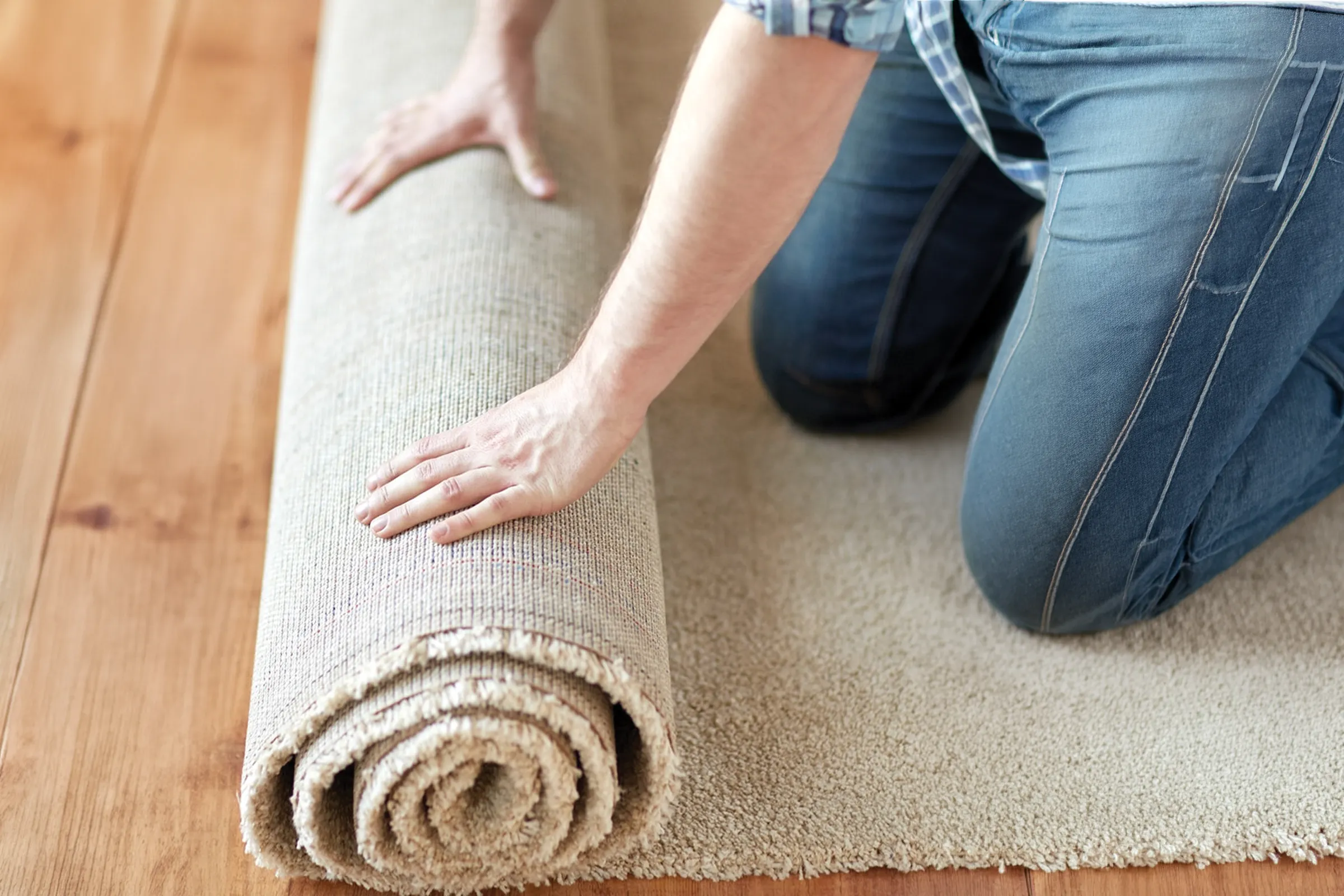
Removing carpet, pad and tack strip from an El Paso slab. This is the day the real condition of the floor becomes visible.
Why we do it free
We are a hard-surface company. We do not sell or install carpet, so removing carpet is not a service we compete on — it is the first hour of the job we actually want. Charging separately for it would mean pricing the same work twice.
It also keeps the quote honest. When removal is bundled, you can compare our number to a competitor’s without working out whether their price includes the teardown, the pad, the tack strip and the dumpster run. It usually does not.
The one thing we do charge for is what the slab needs after the carpet is gone. Levelling, patching beyond normal tack-strip repair, grinding old adhesive, or a crack isolation membrane are real material and labour costs and they appear as their own lines. That is the difference between a bundled service and a hidden one.
Stairs are the other exception worth naming. Removing carpet from a staircase is genuinely slow work — nationally $7 to $10 a step, more for specialty treads — and finishing stairs in a hard surface is a separate scope. If your job includes stairs, ask every bidder to price them as a line item rather than folding them into a square-foot rate.
Details on how we handle the teardown are on our carpet removal page, and the material choices that follow are on the vinyl plank and tile and natural stone pages.
The dust question
Most national articles about ripping out carpet run on dust mites. That argument does not apply here. The American Lung Association notes that dust mites cannot thrive in dry desert environments, and El Paso is about as dry as the continental United States gets — afternoon humidity averages 27% across the year.
The real El Paso case for removing carpet is mineral dust. Wind season runs roughly February through May and it drives fine grit into every house in the city. That grit settles into carpet pile and stays there. Vacuuming pulls out some of it and pushes the rest deeper. On a hard surface the same dust sits on top where a damp mop actually removes it.
The ALA’s own recommendation for allergen control is direct: hard-surfaced flooring in place of carpet. In this climate that recommendation lands for a different reason than the one they wrote it for, and it lands harder. Families who tell us the house “never feels clean” are usually describing carpet in a dust bowl, not a cleaning problem.
If dust is your main reason for the project, two follow-on choices matter. Pick a floor with a smooth rather than heavily embossed surface, because deep texture holds grit the same way pile does. And run the new floor continuously rather than breaking it at every doorway, because thresholds collect exactly what you are trying to get rid of. Our room-by-room guide goes through both.
After the teardown
An honest contractor will tell you the number may move once the slab is visible, and will tell you by how much before continuing. The three things that move it are levelling, moisture and old adhesive. None of them can be seen through carpet.
Levelling. A slab that is out by more than about 3/16 of an inch across a 10 foot span needs self-levelling compound under a floating floor, and a tighter tolerance again under large-format tile. This is the single most common change after removing carpet, and it runs $1 to $6 per square foot depending on depth.
Moisture. Dark patches, white powdery efflorescence at the perimeter, or a musty smell in a Valley house all mean the slab should be tested rather than guessed at. An in-situ probe test to ASTM F2170 gives a real number. Rigid-core vinyl plank tolerates far more slab moisture than glued wood, which is often the answer when a slab reads high.
Old adhesive. Some slabs have residue from a floor two owners ago. It grinds off, but grinding is dusty, slow work and it belongs in the quote.
Removing carpet is loud for an hour and dusty for two. We work room by room, so a family can shuffle beds and keep using the house. The one thing worth planning around is pets: the tack strip stage puts sharp metal and hundreds of staples on the floor, and that is not a room a dog should walk through. Most clients board or crate for the teardown day and are back to normal by evening.
Furniture is the other planning item. Nationally, furniture moving runs $60 to $120 an hour. We waive it on most jobs when the room is cleared before we arrive, so clearing closets and small furniture yourself is the easiest money you will save on the whole project. What we do move is the heavy items nobody should be lifting alone.
Once removing carpet is done and the slab is known, the rest of the job is predictable. That is really the point of doing the teardown properly and pricing it openly: everything after it stops being a guess. Our cost guide shows how each of those line items lands on a real quote, and the free estimate page is where to start if you want the number for your own rooms.
Questions we get
Yes. Carpet and pad compress under load, and a rigid plank floating on a compressible layer will flex at every seam until the locking edges fail. Every manufacturer requires a firm, flat substrate. There is no product on the market rated to go over carpet.
No. Even dense glue-down commercial carpet has enough give to break a click joint over time, and it traps moisture against the slab. Removing carpet is not optional in any of these cases.
The pad, the tack strip around every perimeter, and every staple holding the pad down. On a slab the tack strip is usually concrete-nailed, so it leaves small holes that get patched. Skipping the staples is the most common shortcut and it shows as bumps under the new floor.
Nationally $0.70 to $1.60 per square foot including haul-away. On our jobs it is $0. We are a hard-surface company, so removing carpet and disposing of it is included in any tile, plank, laminate or wood installation we quote.
Bare slab in most homes, sometimes with old adhesive, paint overspray or a skim of drywall mud. In Central and Sunset Heights houses on raised subfloors you occasionally find original wood. In pre-1980 houses, 9×9 vinyl tile that should be treated as possible asbestos.
It helps a lot. The American Lung Association recommends replacing carpet with hard-surfaced flooring for allergen control. In El Paso the issue is wind-blown mineral dust rather than dust mites, which barely survive our humidity. Hard surface lets you actually remove what settles.
Keep reading
Where these numbers come from
Written by the installation crew at El Paso Flooring Pros from work performed on El Paso slabs. Reviewed and last updated September 9, 2026. Any price range shown is a published market range, not a quote — your number comes from a free in-home measure.
Next step
We remove and haul away the old carpet, pad and tack strip at no charge on any hard-surface replacement. Free in-home measure and a written itemized quote.