
How Long Does Flooring Installation Actually Take?
The honest answer is two to seven days for most El Paso homes, and the variable is almost never the material. It is the slab, the demolition and how many rooms you need to keep using while the work happens.
Hablamos Español
- Free in-home estimate
- Written itemized quote
- Hard surface specialists
- Hablamos Español
The short answer
How long does flooring installation take?
Two to seven working days for most El Paso homes. A single-material vinyl plank job over a sound slab runs at the fast end. Tile with demolition and levelling runs at the slow end. Flooring installation time is driven far more by what is under the old floor than by which new floor you picked.
A useful rule of thumb: one day of prep for every one to two days of installing. When a schedule slips, it is almost always the prep half that grew, because that is the half nobody could see through the old carpet.
By material
Flooring installation time by material and square footage
| Material | 500 sq ft | 1,000 sq ft | 1,800 sq ft | What sets the pace |
|---|---|---|---|---|
| Vinyl plank, floating | 1–2 days | 2 days | 3–4 days | Cutting and layout. No cure time at all |
| Laminate | 1–2 days | 2 days | 3–4 days | Same as plank, plus a moisture barrier over concrete |
| Engineered wood, glued | 2 days | 3–4 days | 5–6 days | Adhesive open time and acclimation before starting |
| Ceramic tile | 2–3 days | 4–5 days | 6–8 days | Setting rate, then thinset set and grout cure |
| Large-format porcelain | 3 days | 5–6 days | 8–10 days | Flatness tolerance, heavier handling, more prep |
| Natural stone | 3–4 days | 6 days | 9–11 days | Sorting, sealing and slower setting |
Working days for a two-person crew on a prepared substrate. Add demolition, levelling and stair work separately.
Two notes on that table. First, the numbers assume a prepared substrate. “Prepared” means the old floor is out, the slab is clean, flat and dry, and any crack isolation is already down. Getting to that point is its own line on the schedule and its own line on the quote.
Second, tile durations include waiting, not just working. Thinset has to set before anyone grouts, and grout has to cure before the floor takes traffic or gets washed. A tile crew is not on site for every one of those days, but the room is out of use, and that is what most people actually care about.
Step by step
The seven stages of a flooring installation
Stage 2 is the one people want to skip and should not. Acclimation means the material sits in the house, at the temperature and humidity it will live in, before it is installed. Manufacturers specify it — Mohawk asks for 55 to 85°F during and 24 hours after installation, and wood requires jobsite conditions to be stable for several days beforehand. In El Paso, where spring humidity can be 16%, acclimation is doing real work rather than ticking a box.
Stage 5 is where honest contractors and optimistic ones separate. A slab that needs self-levelling adds at least a day, because the compound has to cure before anything goes on top of it. If a bid has no line for slab prep, the bidder has either priced it into the square-foot rate quietly or is planning to raise it with you mid-job.
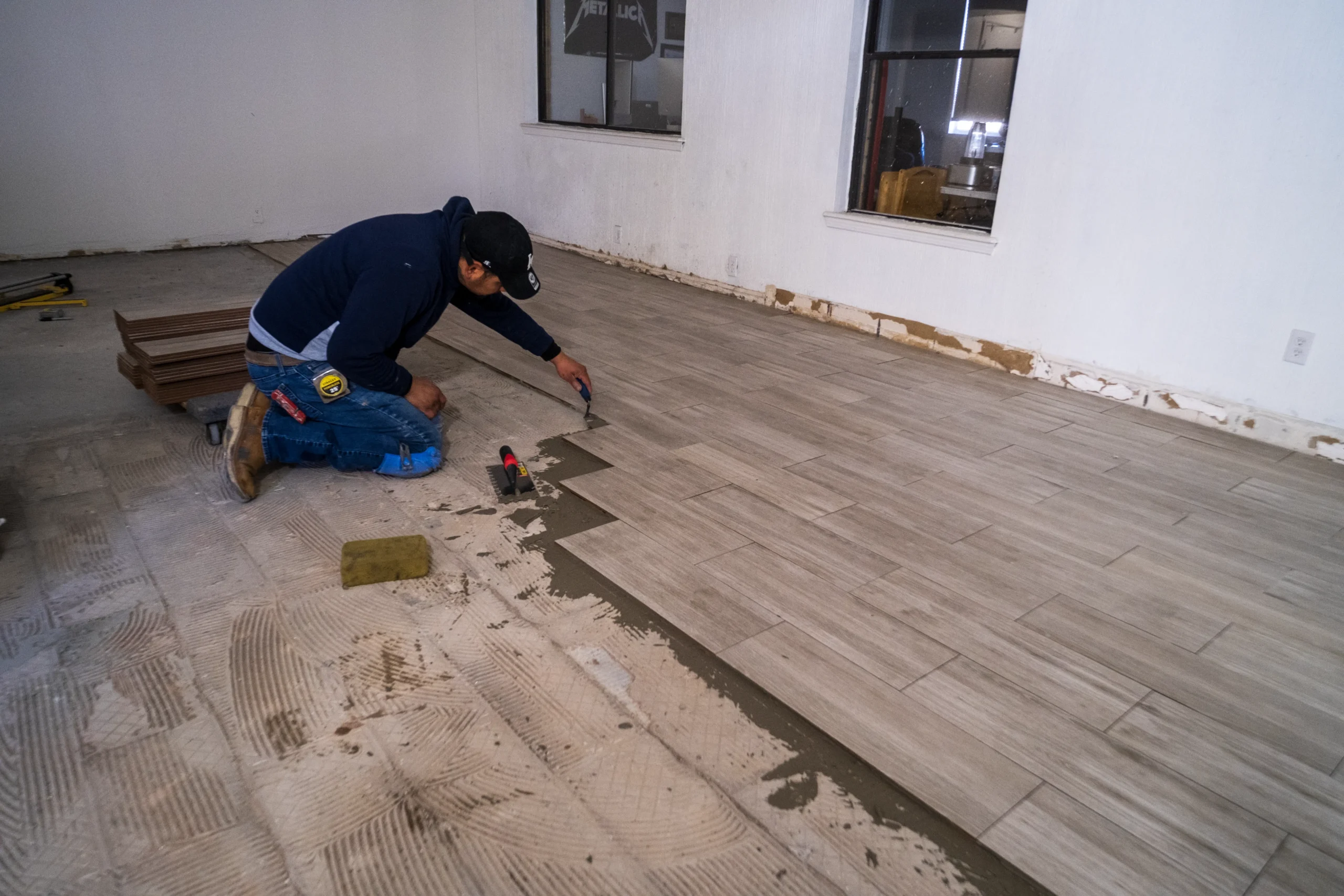
Plank going down in an El Paso house. This stage — the one people picture when they think of flooring installation — is usually the shortest part of the week.
Delays
Five things that make a flooring installation run long
Notice that four of the five are substrate discoveries. This is the central truth of flooring installation scheduling: the material is predictable and the slab is not. A crew laying plank covers 400 to 700 square feet a day almost regardless of the house. Whether the slab under it needs six hours of grinding is the coin-flip.
The fifth one is the only one you control completely. Clearing rooms, emptying closets and taking down anything on the walls near the floor line saves real money as well as time — furniture moving runs $60 to $120 an hour nationally, and most contractors including us waive it when the room is ready.
Weather in El Paso
Two seasons affect scheduling here. Wind season, roughly February through May, makes dust control harder on demolition days and is a reason to seal doorways properly. Monsoon season, 15 June to 30 September, occasionally makes deliveries and outdoor cutting awkward. Neither stops work the way a freeze does elsewhere, which is one genuine advantage of doing a flooring installation in this city.
Living in it
How to stay in the house through a flooring installation
| Stage | Can you use the room? | Rest of the house? | Notes |
|---|---|---|---|
| Demolition | No | Yes | Loudest day. Keep pets out entirely |
| Slab grinding | No | Mostly | The dustiest hour of the project. Doorways get sealed |
| Self-levelling | No, and it needs to cure | Yes | Usually overnight before anything can go on it |
| Plank or laminate install | No, then yes same day | Yes | Walk on it as soon as the room is finished |
| Tile setting | No | Yes | Stay off it entirely until grouted and cured |
| Grouting and curing | No | Yes | Your installer should give you a specific hour to return |
| Baseboards and trim | Briefly no | Yes | Quiet work, mostly a nail gun |
We sequence room by room specifically so there is always a bedroom to sleep in and a bathroom in service.
The room-by-room approach is why most El Paso families stay put through a flooring installation. We finish one space before opening the next, so at no point is the whole house out of action. It takes marginally longer in total than gutting everything at once and it is worth it every time.
Two things to arrange before day one. Somewhere for pets to be during demolition, because tack strip and staples on a floor are genuinely dangerous for paws. And a plan for the fridge if the kitchen is in scope — it usually has to come out, and it needs a place to live for a day or two with power.
If you are working to a hard deadline — a move-in, a PCS date, a family visit — say so at the measure. It changes how we sequence the job and sometimes how we crew it. Our Fort Bliss and PCS page covers short-timeline work specifically, and the free estimate page is where to start. What each material involves is on our services overview.
Scheduling
How to book a flooring installation so the date actually holds
Lead time is the real schedule
People ask how long flooring installation takes and mean the days a crew is in the house. The longer number is usually before that: ordering. Stock products from a local distributor can be in your house in a few days. A special-order tile or a specific plank colour can be three to six weeks. If you have a deadline, the first question is not how fast we work — it is what is actually available.
This is also the strongest argument for the buy-it-yourself route in some cases. If you already have the material sitting in your garage, the flooring installation can start as soon as the crew is free. If we are sourcing it, add the lead time to every estimate on this page.
How we sequence a whole house
Bedrooms first, then the hall, then the main living space, then kitchen and baths last. Two reasons. Bedrooms give you somewhere to retreat while the rest of the house is a worksite, and doing the largest open area later means the crew has already learned how your slab behaves before tackling the room where mistakes are most visible.
Where a job includes both tile and plank, the tile goes first. It is the wet trade, it needs cure time, and running the plank afterwards lets us set the transition heights precisely rather than guessing at them.
What a written schedule should say
Not just a finish date. A real flooring installation schedule names the start date, which rooms are done on which days, when the material is expected to arrive, what happens if the slab needs levelling, and who to call when something changes. If the quote has a total and a vague “about a week”, ask for the rest of it in writing before you sign. Our contractor questions guide covers the whole list, and the cost guide explains how each stage is priced.
Questions we get
Frequently asked questions
How long does flooring installation take for a whole house?
For 1,800 square feet of a single material over a sound slab, plan on three to five working days. Mixed materials, tile demolition or significant levelling push it toward seven to ten. Anyone promising a whole house in one day is describing a crew size, not a schedule.
How long does vinyl plank take to install?
About 400 to 700 square feet a day for a two-person crew on a prepared slab. A 1,000 square foot living area is typically two days including prep, transitions and baseboards. It is the fastest hard-surface flooring installation there is.
How long does tile take?
Roughly half the daily coverage of plank, plus curing. Setting is one to three days for a typical living area, grout goes in the day after the thinset sets, and you stay off the floor while it cures. Budget four to six days for 1,000 square feet.
Can I walk on the floor the same day?
On vinyl plank and laminate, yes, as soon as the room is finished. On tile, no. Thinset needs to set before grouting and grout needs to cure before traffic and cleaning. Your installer should give you a specific hour, not a vague “tomorrow”.
What makes a flooring installation take longer than quoted?
Five things, in order of how often we see them: slab levelling discovered after demolition, tile demolition that is slower than expected, moisture found in the slab, material delivered short or damaged, and furniture that has not been moved.
Do I have to move out during flooring installation?
Almost never. We work room by room so there is always somewhere to sleep and a working bathroom. The exceptions are whole-house tile with heavy demolition, and any job where slab grinding creates dust that is worth being away from for a day.
Where these numbers come from
Sources and standards
- HomeGuide — flooring installation cost and scope data, updated February 2026
- HomeGuide — carpet removal timing and cost, updated February 2026
- Mohawk SolidTech — published acclimation and jobsite condition requirements for rigid vinyl
- Pergo — laminate installation requirements including 60-day concrete cure and moisture barrier
- Ceramic Tile Education Foundation — substrate flatness requirements that drive prep time
Written by the installation crew at El Paso Flooring Pros from work performed on El Paso slabs. Reviewed and last updated September 9, 2026. Any price range shown is a published market range, not a quote — your number comes from a free in-home measure.
Next step
Need it done around a move-in date?
Tell us your deadline and we will tell you honestly whether it is achievable. Free in-home measure, written schedule with the quote, no pressure.