
Why Tile Cracks on an El Paso Slab, and How to Stop It
A cracked tile is rarely a bad tile. In El Paso it is almost always the slab underneath telling you something — and the crack pattern tells you which of four things it is. Here is how to read it before you spend money on a repair that will fail again.
Hablamos Español
- Free in-home estimate
- Written itemized quote
- Hard surface specialists
- Hablamos Español
The short answer
What causes cracked tile on a concrete slab?
In El Paso, cracked tile almost always comes from movement in the slab below, not a defect in the tile. The Tile Council of North America calls it reflective cracking: a shrinkage crack or control joint in the concrete keeps moving, and because tile is bonded rigidly to the slab, the movement transfers straight through the thinset into the tile above.
The other three causes are a void under the tile from poor thinset coverage, a slab that was never flat enough for the tile size, and impact. Each leaves a different pattern, and the pattern is what tells you which repair will actually hold.
Reading the pattern
Four causes of cracked tile, and how to tell them apart
| What you see | Most likely cause | What actually fixes it |
|---|---|---|
| One straight crack through several tiles, wall to wall | A slab shrinkage crack or a control joint tiled over | Remove that run, install a crack isolation membrane over the crack, re-set |
| Cracks following a grout line in a dead-straight run | Tile was bonded across a control joint | Convert that line to a movement joint filled with sealant, not grout |
| Random single tiles, hollow when tapped | Voids from incomplete thinset coverage | Remove and re-set those tiles with full back-buttered coverage |
| Cracks starting at a corner or edge of the tile | Lippage or a slab out of flatness tolerance | Assess flatness; often needs levelling before any re-tile |
| A crack that also appears in a wall or door frame | Real structural movement | Foundation assessment before any flooring work |
| A clean crack under a heavy object with no pattern | Impact | Swap the tile. Nothing else needed |
General diagnostic guidance based on TCNA material and our own repair work. Anything appearing in walls as well as floors deserves a structural opinion.
The single most useful thing you can do before calling anyone is take a photo standing over the crack, and a second photo from across the room at floor level. The overhead shot shows the pattern. The low-angle shot shows lippage and whether the two sides of the crack are at different heights, which separates a shrinkage crack from real differential movement.
TCNA makes an important distinction here. Some slab cracks are stable and some stay “dimensionally active” — they keep opening and closing with temperature and moisture. A stable crack can be filled and tiled over. An active one cannot, and cracked tile above it will keep returning until the movement is isolated rather than bridged.
The El Paso part
Why cracked tile here is not the Texas story you have read
Most Texas content about cracked tile is really about Dallas and Houston, where Blackland Prairie clay swells and shrinks dramatically with moisture. That is a genuine foundation story, and it is not ours.
The USDA soil series whose type location is El Paso County — the Hueco series — is described as coarse-loamy, with 8 to 18 percent clay and a cemented caliche layer at roughly 30 to 34 inches. Geotechnical work in the metro finds low-plasticity sands and silts through the upper strata, with genuinely expansive high-plasticity clay confined to deeper layers and to the Rio Grande floodplain. In other words: El Paso slabs mostly are not being heaved by swelling clay.
What they are doing is shrinking as concrete does, cycling with temperature under a lot of sun, and settling on engineered pads in the newer subdivisions. That is why cracked tile in Horizon City or the far East tends to show up in young houses along a single straight line, while cracked tile in the Valley more often comes with moisture staining. Different mechanisms, different fixes, and neither one is the clay story.
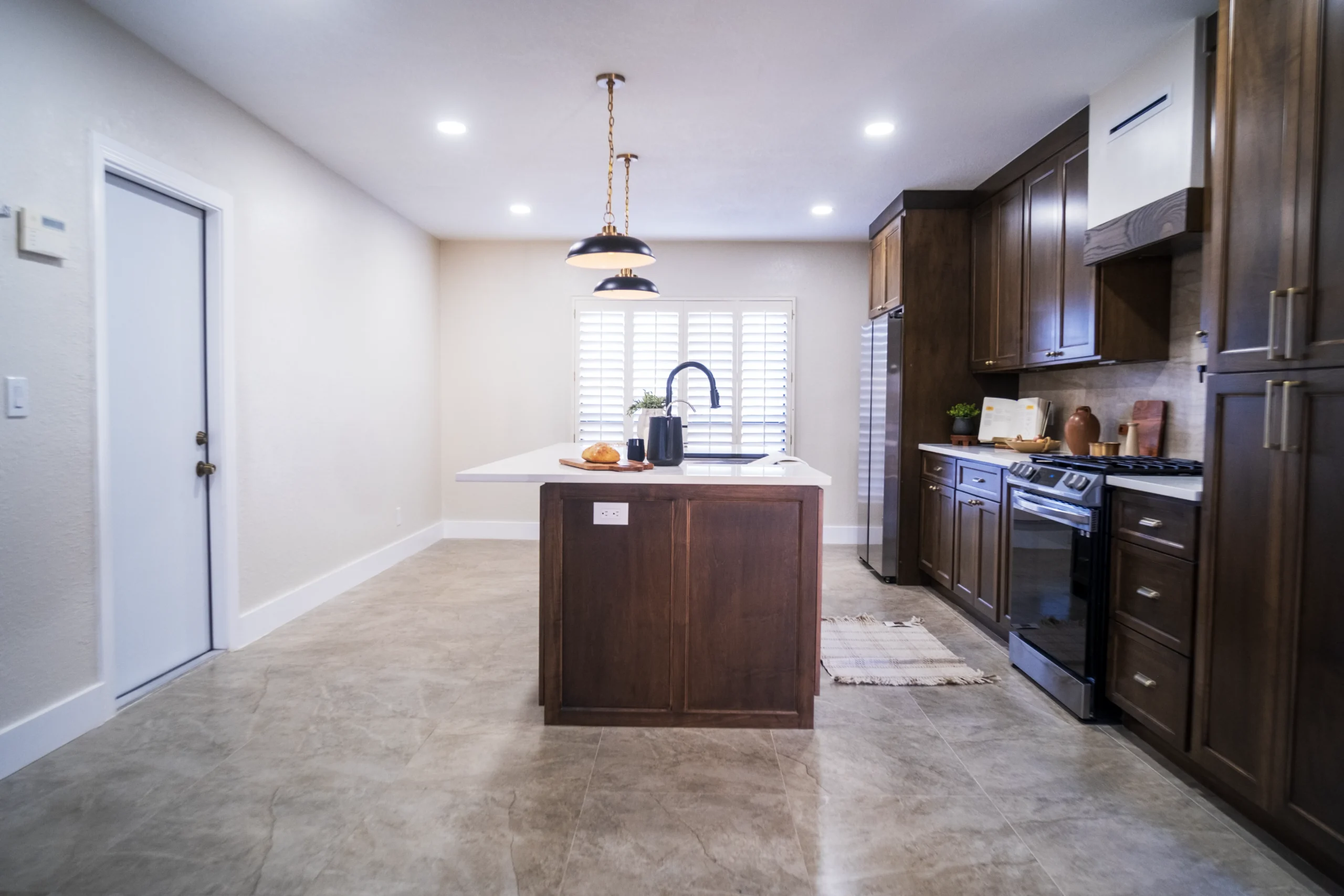
Large-format tile in an El Paso kitchen. Flatness and crack isolation before setting are what keep a floor like this from becoming cracked tile.
Sunlight and joints
The El Paso mistake that guarantees cracked tile
Tile expands when the slab under it heats up. TCNA states plainly that interior movement joints are needed more frequently where direct sunlight is expected. In a city with this much sun and this many west-facing windows, that guidance is not optional fine print — it is the difference between a floor that lasts and cracked tile at the sunny end of the room.
A movement joint is a soft, sealant-filled line that lets the field of tile grow and shrink. Grout is not a movement joint. Grout is rigid, and a tile field with no soft joints has nowhere to go but up or apart.
Three rules follow from that, and all three are things to ask any tile contractor about before work starts.
Perimeter joints. There should be a soft joint at every wall, usually hidden behind the baseboard. If tile is grouted hard against the drywall all the way around a big sunlit room, the floor has been built with nowhere to expand.
Field joints. Large open areas need movement joints in the field, and sun-exposed areas need them closer together than shaded interior rooms. Industry practice puts interior joints in the range of 20 to 25 feet, tightening to 8 to 12 feet where direct sun loads the slab. TCNA publishes the governing detail as EJ171.
Never tile across a control joint. The control joint exists specifically because the slab is expected to crack there. Bonding tile straight over it and grouting the line is the most reliable way to produce cracked tile in a straight line, and it is common.
Sun exposure also explains a pattern we see often: a floor that is perfect through the middle of the house and cracked in the one room with a wall of west glass. Nothing was wrong with the tile. The joint spacing that worked in the hallway was not enough for a slab that gets 40 degrees hotter every afternoon.
Fixing it
What a proper cracked tile repair looks like
Two honest caveats. First, matching an older tile is often impossible — dye lots change and lines are discontinued — which is why we ask every client to keep one unopened box. Second, if the crack shows in walls or door frames as well as in the floor, no flooring repair is the right first step. Get a structural opinion, then come back to the tile.
And if the floor has cracked twice already, it is worth asking whether tile is the right material for that room at all. A floating floor is not bonded to the slab, so the same shrinkage crack that produces cracked tile is invisible under vinyl plank. That trade-off is laid out in our vinyl plank vs tile comparison, and the prep costs are broken out in the El Paso cost guide. What we install and how we prep for it is on our tile and natural stone page.
Prevention
What a new tile floor needs so it never becomes cracked tile
Why the cheap tile bid is usually the expensive one
Every step above costs money and none of it is visible when the job is finished. That is exactly why it gets cut. A bidder who skips the straightedge, skips the membrane and grouts hard to the walls can be genuinely cheaper by a few thousand dollars on a big living area, and the floor will look identical on handover day.
You find out the difference in year two or three, when a straight line of cracked tile appears across the room. At that point the repair costs more than the prep would have, because now the finished floor has to be broken out to do the work that should have happened underneath it.
So when you compare tile bids, do not compare bottom lines. Compare whether slab preparation, crack isolation and movement joints appear as named line items. If they do not appear, they are not priced, and cracked tile is the eventual result. Our contractor questions guide lists exactly what to ask, and the free estimate page is where to start if you want your own slab looked at.
Questions we get
Frequently asked questions
Why does my tile keep cracking in the same line?
Because the crack is not in the tile, it is in the slab underneath, and it is reflecting through. The Tile Council of North America calls this reflective cracking. Replacing the cracked tile without isolating the slab crack gets you the same failure in the same line within a year or two.
Is a cracked tile floor a foundation problem?
Sometimes, but far less often in El Paso than in Dallas or Houston. Our upland soils are sandy and low-plasticity with caliche rather than the expansive clay that drives foundation heave in central Texas. Most cracked tile here traces to ordinary slab shrinkage or a control joint that was tiled over.
Can you fix cracked tile without replacing the whole floor?
Often yes. A single cracked tile from a dropped object is a straightforward swap. A line of cracked tile following a slab crack needs that section removed, a crack isolation membrane installed over the crack, and the tile re-set. The rest of the floor usually stays.
What is a crack isolation membrane?
A flexible layer installed between the slab and the tile that lets the slab move without transmitting that movement to the tile above. Products meeting ANSI A118.12 are rated to bridge either 1/16 inch or 1/8 inch of movement, and they are installed per ANSI A108.17.
Why is there a straight crack running through several tiles?
That is the signature of a slab control joint or a shrinkage crack under the floor. Straight, continuous, running wall to wall. Cracked tile in a random scatter is a different problem, usually impact or a void in the thinset.
Does hollow-sounding tile mean it will crack?
It means it has lost bond with the slab, so it has no support under it. Hollow tile is much more likely to become cracked tile the first time something heavy lands on it. Tap the floor with a knuckle; the change in sound is obvious once you hear it.
Where these numbers come from
Sources and standards
- Tile Council of North America — cracked tile, reflective cracking and dimensionally active slab cracks
- Tile Council of North America — movement joints, detail EJ171, and direct sunlight
- TCNA — ANSI A118.12 crack isolation membranes and A108.17 installation
- USDA NRCS — Hueco soil series, type location El Paso County, caliche at 30–34 inches, 8–18% clay
- Ceramic Tile Education Foundation — ANSI A108.02 flatness tolerances for large-format tile
Written by the installation crew at El Paso Flooring Pros from work performed on El Paso slabs. Reviewed and last updated September 9, 2026. Any price range shown is a published market range, not a quote — your number comes from a free in-home measure.
Next step
Have a crack running across your floor?
We will look at the pattern, sound the surrounding tile and tell you whether it is a repair, a re-set with crack isolation, or a slab conversation. Free visit, honest answer.
Hablamos Español