
What a Swamp Cooler Does to Your Wood Floors
An evaporative cooler works by putting water into your air. That is the whole mechanism. In a city where spring afternoons sit at 16% humidity, it means your house swings further and faster than almost anywhere in the country — and wood floors feel every point of it.
Hablamos Español
- Free in-home estimate
- Written itemized quote
- Hard surface specialists
- Hablamos Español
The short answer
Is a swamp cooler bad for wood floors?
A swamp cooler is not bad for wood. The annual swing it creates is what wood reacts to. A swamp cooler adds moisture to your air on purpose, so a swamp-cooled El Paso house runs comfortably humid from May through September and then drops back toward 27% for the rest of the year.
That cycle is larger than what most of the country experiences, and it runs in the opposite direction to the national pattern. Engineered wood handles it. Solid wood shows it. Laminate is the one material we would actively steer away from in a swamp-cooled house, because its fibreboard core is the least tolerant of sustained moisture.
The annual cycle
Why a swamp cooler makes El Paso humidity run backwards
Follow the year through a swamp-cooled house and the problem becomes obvious.
April and May. Outdoor afternoon humidity averages 16%, the driest of the year. The swamp cooler is not running yet. Indoors is bone dry and wood is at its most shrunken. This is when seasonal gaps are widest.
May through September. The swamp cooler runs. It is adding somewhere in the region of 30 to 40 percentage points of relative humidity to the air passing through it. Indoors becomes genuinely humid, and every board in the house takes moisture back on and swells.
Mid-June through September. The monsoon arrives, so outdoor humidity climbs too — morning readings go from 35% in May to 59% in August. Now the swamp cooler is adding humidity to air that already has more of it. This is the wettest the house will be all year.
October. The swamp cooler shuts off. Indoor humidity falls back toward ambient within days, and the wood begins shrinking again.
Two full expansion-and-contraction cycles a year, with the wet peak in the middle of summer. Every national article about wood floor gapping assumes the opposite phase, which is why generic advice lands wrong in this city.
The four risks
What actually goes wrong, and how likely it is
| Risk | What it looks like | How likely | What reduces it |
|---|---|---|---|
| Seasonal gapping | Thin gaps at every seam in spring, closed by August | Very common, and normal | Engineered construction and narrower boards |
| Cupping near the cooler | Board edges higher than centres in the hallway or the room the air dumps into | Occasional | Balance the airflow; open a window so air actually moves through |
| Laminate core swelling | Seams swell and never go back down | Uncommon but permanent | Do not use laminate in a swamp-cooled house |
| Shock from converting to refrigerated air | Gaps that used to close stop closing | Increasingly common in El Paso | Plan the floor and the conversion together |
Frequency reflects what we see on service calls in El Paso homes. Any cupping should be investigated rather than waited out.
The airflow detail nobody mentions
A swamp cooler only works if the air it pushes in can get out. If the house is closed up tight, humid air recirculates instead of exhausting, and indoor humidity climbs higher than it should. That is when cupping shows up. Cracking a window at the far end of the house is not wasting cool air — with a swamp cooler running it is how the system is supposed to run, and it is also the cheapest thing you can do for a wood floor.
Where damage appears first
Directly under and downstream of the swamp cooler. In most El Paso houses that is the central hallway with the ceiling unit and the first room the air reaches. If you are going to check anything, check the boards there in August. Run a hand across them; a cupped board is easier to feel than to see.
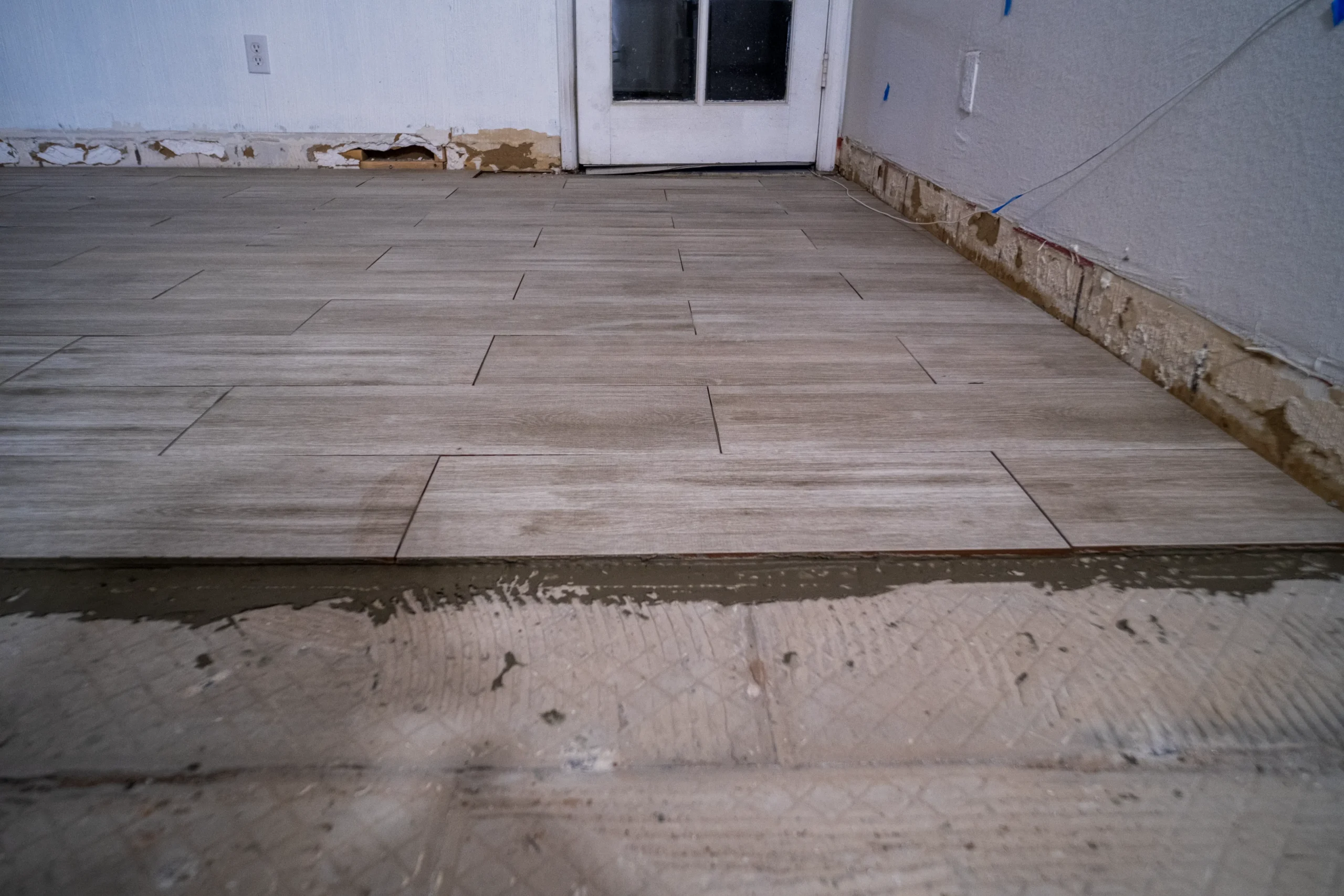
Wide-plank flooring in an open El Paso room. In a swamp cooler house, board width and core construction decide how visible seasonal movement becomes.
The conversion
Switching from a swamp cooler to refrigerated air
A great many El Paso homeowners are converting from a swamp cooler to refrigerated air. It is a comfort upgrade and a water saving. It is also a permanent step-change to drier indoor air, and any wood or laminate floor already in the house will have to find a new equilibrium.
Practically: gaps that used to close every July may stop closing. Boards may shrink slightly further than they ever have. Nothing catastrophic happens, but the floor will look a little different, and it is far better to expect it than to discover it.
If you are doing both projects, sequence matters. Convert to refrigerated air first, live with it through one full summer, then install the new floor. The wood then acclimates to the conditions it will actually live in rather than to a house that is about to change underneath it.
If the floor is already down and the conversion is happening anyway, three things help. Run a humidifier through the first dry season so the change is gradual rather than abrupt. Keep an eye on the shoulder months. And accept that a solid wood floor installed for swamp-cooler humidity will show more movement afterwards than it used to.
The opposite sequence — new floor first, then conversion a year later — is the one that generates service calls. It is not the floor failing. It is a floor that acclimated correctly to conditions that no longer exist.
What we recommend
The floors that do not care how you cool the house
Here is the honest summary. If you cool with a swamp cooler and you want a floor you will never think about again, install rigid-core vinyl plank or porcelain tile. Neither contains wood fibre. Neither moves with humidity. You can run the cooler flat out for five months, shut it off in October, convert to refrigerated air in three years, and the floor will not notice any of it.
If you want real wood in a swamp-cooled house, install engineered wood in a 3 to 5 inch board, put a hygrometer on the shelf, and understand that the floor will move a little twice a year. That is a completely reasonable trade for a material people love, as long as nobody sold it to you as maintenance-free.
If someone is trying to sell you laminate for a swamp-cooled house, ask them what the core is made of. We install laminate and we still say this: in a house that is deliberately humidified for five months a year, a fibreboard core is the wrong bet, and the failure is not repairable when it happens.
The full comparison across every material, scored for El Paso conditions specifically, is in our best flooring guide, and the humidity data behind all of this is laid out in wood floors in a dry climate.
Month by month
A swamp cooler year, and what your floor is doing
Reading that calendar
The two moments that matter are the changeovers. When the swamp cooler starts in May, indoor humidity can jump 30 or 40 points in a single day. When it stops in October, it falls just as fast. Wood does not mind humidity; it minds sudden humidity. Bringing the cooler up gradually over a few days in May, and running the fan without the pump for a week in October, softens both transitions more than anything else you can do.
Why this is a flooring conversation and not just an HVAC one
Every flooring manufacturer publishes service conditions — a temperature and humidity band the product is warranted within. Read them and you will find most wood and laminate products specify something like 35 to 55% relative humidity. A swamp cooler house in July can run above that band, and the same house in April runs well below it. Technically, a floor in a swamp cooler house spends part of the year outside its published service conditions in both directions.
That is not a reason to panic and it is not usually a warranty fight. It is a reason to choose a material whose service conditions your house can actually meet. Vinyl plank and porcelain tile have no meaningful humidity limits at all, which is precisely why they have become the default in swamp-cooled El Paso houses.
One last practical note
If you are installing a new floor during the months the swamp cooler is running, tell your installer. Acclimation targets and expansion gaps should be set for the conditions the floor will live in across the whole year, not for the humid week it happens to be delivered in. An installer who does not ask how you cool the house has not thought about it, which is worth knowing before you sign. Our contractor questions guide covers the rest of what to ask.
Questions we get
Frequently asked questions
Does a swamp cooler damage wood floors?
Not by itself. What stresses wood is the size of the annual swing. A swamp cooler deliberately raises indoor humidity for four or five months and then stops, so the house cycles between comfortably humid in July and very dry by October. Wood expands and contracts across that cycle.
How much humidity does a swamp cooler add?
A university extension study of semi-arid climates measured indoor relative humidity increases of roughly 40 percentage points under dry pre-monsoon conditions and about 30 points during monsoon conditions. The Department of Energy states plainly that evaporative coolers add humidity to the air in your home.
Is laminate or vinyl plank safer with a swamp cooler?
Vinyl plank, clearly. It has no wood fibre, so humidity does not move it. Laminate has a fibreboard core that reacts to sustained moisture, which makes it the riskiest hard surface in a swamp-cooled house, especially near the cooler itself.
What happens to my floors if I switch to refrigerated air?
Indoor humidity drops permanently. An existing wood or laminate floor that equalised to swamp-cooled summers will shrink to a new, drier baseline, and gaps that used to close in July may not close again. Plan the conversion and the floor together where you can.
Should I avoid wood floors if I have a swamp cooler?
No, but choose engineered rather than solid, keep boards narrower, and watch the shoulder seasons. The risky months are the changeovers — the weeks after you fire the cooler up in May and the weeks after you shut it down in October.
Where do problems show up first in a swamp-cooled house?
Closest to the cooler and along the path the air takes. In most El Paso houses that is the hallway under the ceiling unit and the room the air dumps into. That is where you will see cupping first if the humidity is running high.
Where these numbers come from
Sources and standards
- U.S. Department of Energy — evaporative coolers add humidity to the air in your home; 15–40°F cooling effect
- University of Arizona Cooperative Extension AZ1444 — measured indoor humidity increases from evaporative cooling in semi-arid climates
- NOAA NCEI — Comparative Climatic Data, El Paso mean relative humidity by month
- National Wood Flooring Association — 30–50% indoor relative humidity, cupping and gapping
- National Weather Service El Paso — monsoon season defined as 15 June to 30 September
Written by the installation crew at El Paso Flooring Pros from work performed on El Paso slabs. Reviewed and last updated September 9, 2026. Any price range shown is a published market range, not a quote — your number comes from a free in-home measure.
Next step
Choosing a floor for a swamp-cooled house?
Tell us how you cool the house and we will tell you which floors will be happy in it. Free in-home measure, itemized written quote, honest recommendation.
Hablamos Español