
Swamp cooler and wood floors
What evaporative cooling does to indoor humidity, and to your floor.
Read moreThe National Wood Flooring Association asks you to keep your house between 30% and 50% relative humidity. El Paso afternoons average 27% across the year and drop to 16% in April and May. That gap is the whole story, and almost nobody selling wood in this city will show you the numbers.
Hablamos Español
The short answer
Yes, with two conditions. Choose engineered construction, and accept that hardwood floors will move seasonally. Hardwood floors in this city live below the humidity range the industry recommends for most of the year, and no amount of acclimating hardwood floors changes the air in your house.
What acclimation and good installation do change is how the movement shows up. Done properly you get hairline seasonal gaps that open in April and close in August. Done badly you get boards that cup, crown, or pull loose from the subfloor.
The data
Look at the shape rather than the numbers for a moment. Two things about that chart are unusual and they both matter for hardwood floors.
The whole curve sits low. Afternoon humidity is under the recommended 30% floor for ten months of the year. This is not a winter heating-season problem the way it is in Chicago. It is the baseline condition.
The curve runs backwards. In most of the country indoor humidity bottoms out in winter. Here it bottoms out in spring — 16% in April and May — and then rises when the monsoon arrives from mid-June through September. So gaps in hardwood floors here open in April and close in August, which is the opposite of everything written for a national audience.
If someone quoting hardwood floors talks about winter gapping, they are reciting national content. Ours is a spring problem.
The physics
| Relative humidity | Wood equilibrium moisture content | What it means for a floor |
|---|---|---|
| 15% | 3.5% | Well below manufactured moisture content. Maximum shrinkage |
| 20% | 4.5% | Typical El Paso spring afternoon |
| 25% | 5.4% | Still below the range flooring is dried to |
| 30% | 6.2% | The bottom of the NWFA range. Wood is at its dry limit |
| 40% | 7.7% | Comfortable. Boards sit where they were made to sit |
| 50% | 9.2% | Top of the NWFA range |
| 60% | 11.0% | Above range. Boards swell and can cup |
Equilibrium moisture content values from the USDA Forest Products Laboratory Wood Handbook. Flooring is typically manufactured at 6 to 9% moisture content.
Put the two tables together and the mechanism is obvious. Hardwood floors are manufactured at 6 to 9% moisture content, which corresponds to roughly 30 to 50% relative humidity. Sit that floor in an El Paso spring at 16% humidity and the wood drifts toward about 3.5 to 4% moisture content. Every board gives up moisture and shrinks slightly across its width.
The NWFA puts a number on the scale of it: a 5-inch red oak plank moves about 0.089 inches across a 30-point humidity swing. That is under a tenth of an inch per board, which sounds like nothing. Across a 10-foot room of 5-inch boards it adds up to more than two inches of total movement, distributed as a thin gap at every seam.
None of this makes hardwood floors a mistake. It is not damage. It is wood behaving exactly as wood behaves. The engineering question is how to make hardwood floors hide that movement, and there are three levers: construction, width and humidity control.
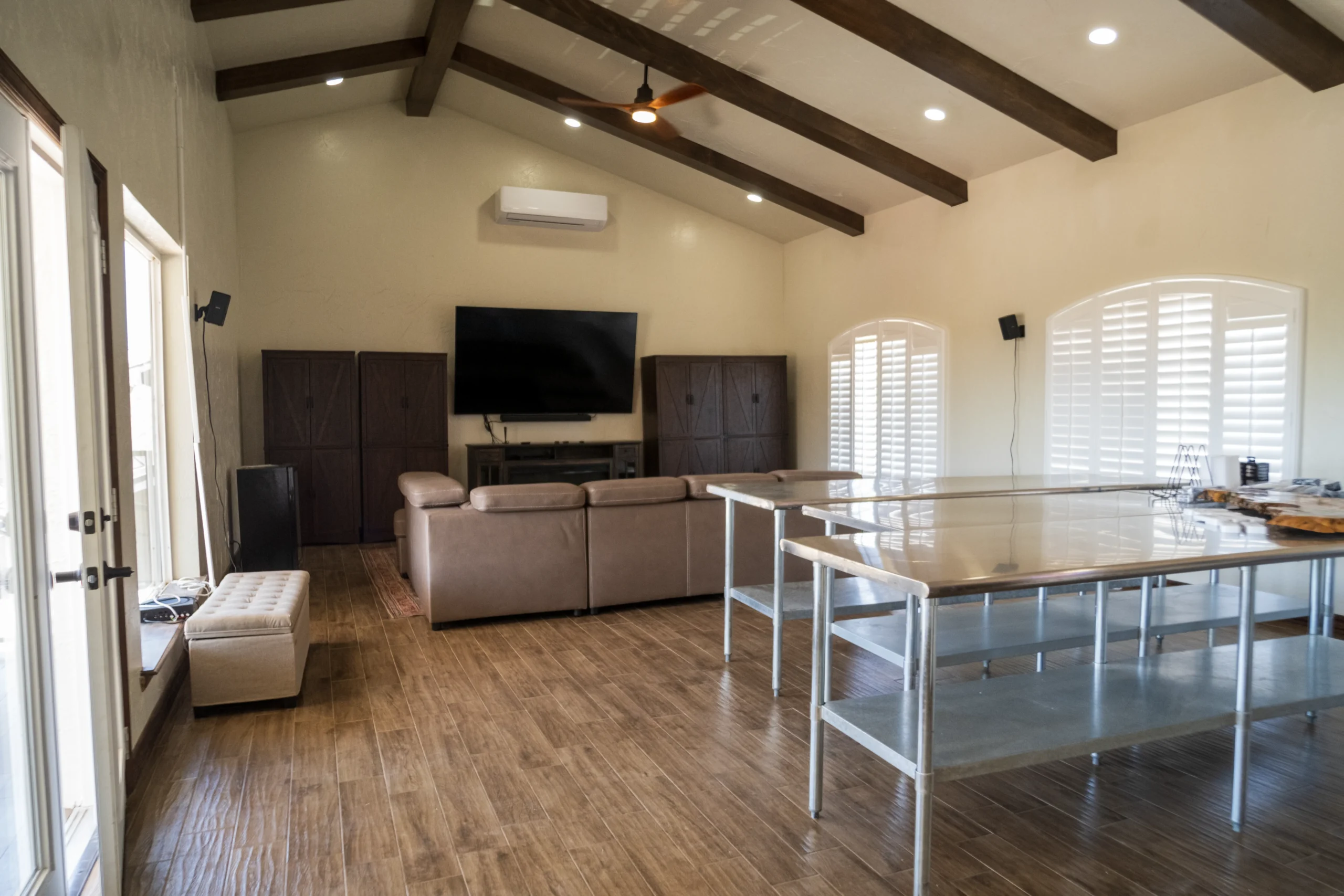
Wood flooring in an El Paso living room. Engineered construction and a moderate board width are what keep seasonal movement out of sight here.
What actually works
Engineered wood is not a compromise product any more. A good engineered board has a genuine sawn hardwood wear layer over a cross-laminated core, and that core is what refuses to move with humidity. In a climate that swings from 16% to comfortable and back every year, that stability is worth more than the extra sanding life a solid board offers.
Solid hardwood floors are still possible here. The American Hardwood Information Center is clear that solid is acceptable on-grade and above-grade, but over a concrete slab it needs a plywood-on-slab or sleeper subfloor system plus a vapor retarder — not direct glue or direct nail into the slab. That adds height at every doorway and real cost, and it is the part that surprises people who priced solid wood from a big-box shelf tag.
National articles treat acclimation as the fix. It is not, and here is why: acclimation brings the wood to equilibrium with your house, but your house sits at 27% humidity. All acclimation does in El Paso is ensure the boards are already shrunk when you install them, so the gaps do not all appear in month two. That is genuinely valuable. It does not stop seasonal movement, because nothing does except controlling the air.
Living with it
| What you see | Normal? | What it usually means |
|---|---|---|
| Thin gaps at seams in April, closed by August | Yes | Ordinary seasonal shrinkage in a dry-spring climate |
| Gaps still open in September | No | Sustained low indoor humidity, or over-dry material at install |
| Board edges higher than centres (cupping) | No | Moisture reaching the underside; check the slab and any leaks |
| Board centres higher than edges (crowning) | No | Often a floor that was sanded while still cupped |
| A gap in one area only | No | Localised moisture, a subfloor issue or a fastening problem |
| Faint creak in one spot in winter | Usually | Fasteners working slightly as the assembly shrinks |
Behaviour patterns follow NWFA problem-prevention guidance. Anything on the “no” rows is worth a professional look rather than a wait-and-see.
The single most useful habit for anyone with hardwood floors in El Paso is a $15 hygrometer sitting on a shelf in the main living area. Not because you will chase a perfect number, but because it turns an argument into a measurement. When the floor gaps in April and the meter reads 18%, you know exactly what happened and that it will close.
If you want to narrow the swing, a whole-house humidifier tied to the HVAC is the real tool. Portable units help one room. And if the house runs on an evaporative cooler, understand that you are deliberately adding humidity for four months and then removing it — which is its own conversation, covered in our swamp cooler and wood floors guide.
What we install, and where we would send you to a different material instead, is on our hardwood and engineered wood page. For bathrooms and laundry rooms we will always send you to vinyl plank or tile, because wood does not belong on a wet floor in any climate.
Cost and care
The sticker shock on solid hardwood floors in El Paso is rarely the wood. It is the subfloor system underneath. Building a plywood-on-slab or sleeper assembly with a vapor retarder adds material, labour and height, and the height cascades into door undercuts, threshold transitions and sometimes an appliance that no longer fits. Engineered hardwood floors avoid all of that because they can be glued or floated directly over a prepared slab.
Two local factors change the routine. The first is grit. Fine wind-blown dust is abrasive, and dragging it around under a mop is what dulls a finish. Dry-sweep or vacuum with a hard-floor head before any damp cleaning, and put a real mat at every exterior door — the first eight feet of any El Paso entry does more damage than the rest of the house combined.
The second is water. Our tap water averages about 10 grains per gallon of hardness, so a wet mop leaves mineral residue on a wood finish just as it does on tile. Use the manufacturer’s recommended cleaner and a barely damp pad. Never wet-mop hardwood floors, and never use vinegar on them — the acid dulls polyurethane over time.
Solid hardwood floors can be sanded several times over their life. Engineered can be sanded once or twice depending on wear-layer thickness, and some thin-wear-layer products cannot be sanded at all. Ask for the wear layer in millimetres before you buy, because it decides whether you own a 25-year floor or a 60-year one.
One El Paso-specific warning about refinishing: never sand a floor that is currently cupped. Cupping is a moisture imbalance, and sanding a cupped floor flat means that when it dries and flattens on its own, the sanded edges end up lower than the centres. That is how crowning happens, and it is not repairable without replacing boards.
If you want real wood in an El Paso house, engineered hardwood floors in a 3 to 5 inch board, installed over a properly prepared slab, with a hygrometer on the shelf and a humidifier if you can manage one. If you want the look with none of the maintenance, wood-look porcelain or a good rigid-core plank gets you 90% of the way there for less money and zero seasonal drama. We install all of it, and we will tell you which one fits your rooms.
Questions we get
Yes, and we do. The realistic version is engineered wood rather than solid, narrower boards rather than very wide ones, and an owner who understands that seasonal gaps open in spring and close during the monsoon. That is normal behaviour here, not a defect.
Because wood equalises with the air around it. At 16% relative humidity, wood drifts toward roughly 3.5 to 4.5% moisture content, while flooring is manufactured at 6 to 9%. Losing that moisture shrinks every board slightly, and the shrinkage shows up as gaps at the seams.
Usually not. Gaps that open in the dry spring and close again when monsoon humidity arrives in July are seasonal and expected. Gaps that stay open through a humid September, or that appear in only one part of the room, are worth having looked at.
Engineered, in almost every El Paso case. A cross-layered core moves far less with humidity swings, and it can be floated or glued over a slab. Solid wood over a slab needs a plywood or sleeper subfloor system, which adds height and cost most people have not budgeted for.
Both, and that is the problem. Evaporative coolers add humidity by design, so a swamp-cooled house can run comfortably humid in July and then collapse back toward 27% when the cooler shuts off in October. It is the size of the swing, not the level, that moves wood.
Narrower. A 3 to 5 inch board moves less in absolute terms than an 7 or 8 inch plank, so the same percentage of shrinkage produces a visibly smaller gap. If you want wide boards in El Paso, engineered construction matters even more.
Where these numbers come from
Written by the installation crew at El Paso Flooring Pros from work performed on El Paso slabs. Reviewed and last updated September 9, 2026. Any price range shown is a published market range, not a quote — your number comes from a free in-home measure.
Next step
We will tell you honestly whether wood suits your rooms, your humidity and your budget — including when it does not. Free in-home measure, written quote.
Hablamos Español