
12 Questions to Ask a Flooring Contractor in El Paso
Texas does not license flooring contractors at the state level. There is no registry to look anyone up in, which means “are you licensed?” is the wrong first question here. These twelve questions to ask are the ones that actually tell you who you are dealing with.
Hablamos Español
- Free in-home estimate
- Written itemized quote
- Hard surface specialists
- Hablamos Español
Start here
Why the questions to ask are different in Texas
Texas does not license flooring contractors at the state level. There is no state registry, no licence number to verify and no board to complain to. So the questions to ask are not about credentials — they are about insurance, written scope, payment structure and whether the person in front of you has actually looked at your slab.
That sounds alarming and it is manageable. The questions to ask simply move from credentials to evidence. Every protection you need can be established in one conversation and one document, and the twelve questions to ask below are what establish it. A contractor who answers all twelve without hedging is almost certainly fine.
The twelve
Twelve questions to ask before you sign anything
If you only use three of these questions to ask, use questions to ask numbers 7, 8 and 9. Those three cover the slab, the contingency and the demolition — the three places where a cheap bid is usually cheap because something has been left out rather than because the contractor is efficient.
Red flags
What the wrong answers sound like
| What they say | What it usually means | What to do |
|---|---|---|
| “About $5 a foot, sight unseen” | Nobody has looked at your slab | Ask for a measure. A range on the phone is fine; a firm price is not |
| “I can do it cheaper for cash” | No paper trail, likely no insurance | Decline. You have no recourse when something goes wrong |
| “This price is only good today” | Pressure tactic | Any real bid holds for at least a week |
| “I need the full amount to buy material” | A deposit is normal; the whole job is not | Offer a material deposit against a receipt |
| “We will figure out the levelling later” | A change order is coming | Get the rate in writing now, before demolition |
| “Do not worry about the crack, tile covers it” | No crack isolation is planned | Ask specifically about ANSI A118.12 membrane |
| A bid 40% below the other two | Something is missing from the scope | Compare line by line, not bottom line |
Red flags consistent with Texas Attorney General and Texas Department of Insurance consumer guidance, plus our own experience of the repairs we get called to fix.
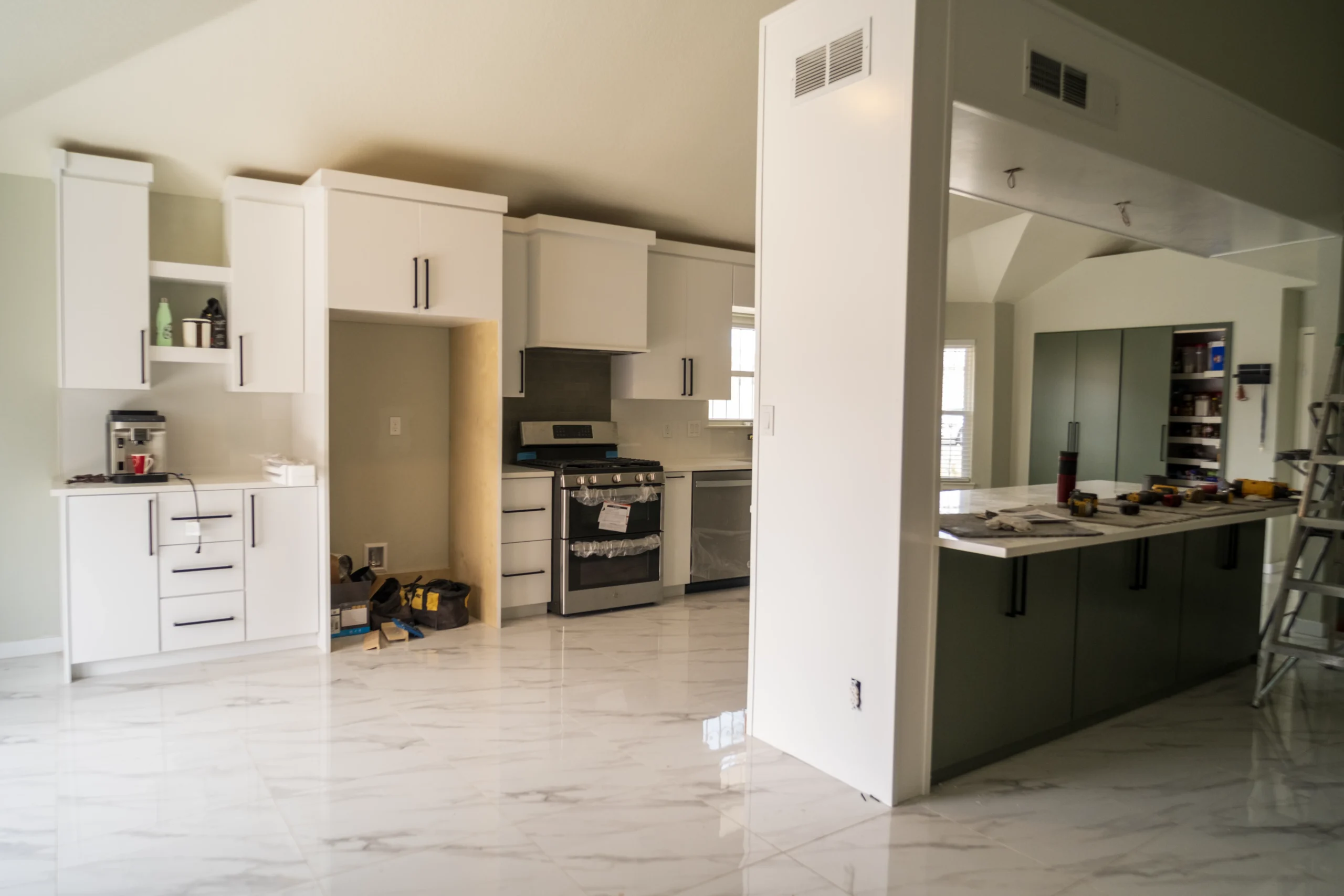
A finished tile kitchen in El Paso. Everything that makes a floor like this last happened before the first tile was set.
If it goes wrong
What Texas law actually gives you
Texas has a Residential Construction Liability Act in Chapter 27 of the Property Code. It generally requires a homeowner to give the contractor written notice of a defect by certified mail and an opportunity to inspect and respond before filing suit.
That is not a reason to avoid contractors. It is a reason to keep everything in writing from the beginning, because the process assumes there is a documented scope to compare the finished work against.
Beyond the questions to ask at the quote stage, three habits are worth more than any legal knowledge. Keep the signed itemized quote. Keep photographs of the slab after demolition and before installation — five minutes with a phone, and it is the single most useful evidence there is if a floor fails later. And pay by a traceable method rather than cash, so there is a record of what was paid and when.
It also means the questions to ask about warranty deserve a real answer. There are two warranties on every floor: the manufacturer’s warranty on the material, which covers defects in the product, and the contractor’s workmanship warranty, which covers the installation. They are separate, they have different terms, and a great many disputes are really an argument about which one applies. Get both in writing.
Where to look for outside signal
Some of the questions to ask cannot be answered by the contractor at all. With no state licence to check, third-party signals do some of that work. Trade association membership — the National Tile Contractors Association, for example — is voluntary but tells you someone invested in doing the work to a standard. Review count and recency matter more than a perfect star rating; a contractor with sixty reviews over two years is a more reliable signal than one with eight perfect ones from the same month.
Our answers
How we answer these questions to ask, in advance
It would be strange to publish questions to ask a contractor of questions to ask a contractor without answering them ourselves, so here they are in the same order.
1–2. We carry general liability insurance and will have the certificate sent to you directly. You will be told who is working in your house before they arrive.
3–5. We work only in the El Paso metro — El Paso proper, Horizon City, Socorro, Canutillo, the Upper Valley and Fort Bliss. Every job on our gallery page is our own work, photographed in local homes, not stock imagery.
6, 9, 12. Every quote is itemized and written. Carpet removal, pad, tack strip and haul-away are included at no charge on any hard-surface installation, and the schedule is part of the quote rather than a verbal estimate.
7–8. We straightedge the slab and will tell you the tolerance we are working to and the per-square-foot rate if levelling is needed, before demolition rather than after. That is the answer to the most important of the questions to ask on this whole page.
10–11. Workmanship warranty in writing, separate from the material warranty. Payment is staged: a material deposit, then progress, then the balance when you have walked the finished floor with us.
You should hold every contractor you talk to — including us — to all twelve. If the answers are good, the rest of the project is mostly logistics. Start with our free estimate page or read what we actually install on the services overview, and see how we handle reviews honestly on the reviews page.
Before the visit
Questions to ask yourself before any contractor arrives
Why homework changes the answers you get
The questions to ask a contractor work best when you have already answered these six for yourself. If three companies measure the same rooms, for the same material, with the same understanding of what is coming out, then the differences between their bids are real differences in scope and skill rather than noise.
Of all the questions to ask yourself, budget is the one people resist, and it is the part that helps most. A contractor who knows your ceiling can tell you what fits within it — a different tile, plank instead of tile in the bedrooms, phasing the job across two visits. A contractor who does not know it just quotes the version they would like to sell.
Two questions to ask that most people forget
“What would you do differently if this were your house?” Of all the questions to ask a flooring contractor, this is the one whose answer tells you whether someone is thinking about your floor or reciting a script. Ours is usually about slab prep or material choice, and it often costs us money to say.
“What is the one thing most likely to go wrong on this job?” Every project has one. A contractor who says “nothing” has not looked hard enough. A contractor who names it — the slab dip in the hallway, the doorway clearance at the back door, the dye lot on a discontinued tile — is telling you they have already thought through the failure modes.
After the bids come in
Lay the three quotes side by side and compare line items, not totals. Check that all three measured the same square footage; a 10% difference in measured area usually means someone estimated rather than measured. Check that removal, disposal and slab prep appear on all three. Then, if one bid is dramatically lower, go back to that contractor with the missing lines and ask them to price them. Sometimes it was an oversight and the corrected number is still the best. Often the gap closes entirely.
These twelve questions to ask a flooring contractor turn a stressful decision into a comparison you can actually reason about. For the numbers to compare against, our El Paso flooring cost guide publishes real 2026 market ranges by material and line item.
Questions we get
Frequently asked questions
Do flooring contractors need a license in Texas?
Not at the state level. Texas does not issue a statewide flooring contractor licence, so there is no registry to check. That is exactly why the questions to ask here centre on insurance, written scope and payment structure rather than a licence number.
What insurance should a flooring contractor carry?
General liability at minimum, and workers compensation if they have employees. Ask for a certificate of insurance sent directly from the insurer or agent rather than a photocopy. It should name the policy period so you can see it is current on your install dates.
How much should I pay up front?
A deposit that covers material is normal. Paying the full amount before work starts is not. The Texas Attorney General warns specifically against large upfront payments and against signing any contract with blank spaces in it.
What are the biggest red flags?
A price quoted without measuring, a refusal to itemise, pressure to decide today, a demand for cash, no written warranty, and a bid dramatically below every other bid. That last one usually means slab preparation has been left out.
What if the work is defective after it is finished?
Texas has a Residential Construction Liability Act process. It generally requires giving the contractor written notice by certified mail and an opportunity to inspect and respond before a lawsuit. Knowing that exists is one of the better questions to ask before you sign anything.
Should I get three quotes?
Yes, and the Texas Attorney General recommends it. The value is not in finding the cheapest number. It is that three bids on the same rooms expose which one has left something out, which is almost always slab preparation or old floor removal.
Where these numbers come from
Sources and standards
- Texas Attorney General — how to avoid home improvement scams, multiple bids and blank contracts
- Texas Department of Insurance — contractor scams, three bids on letterhead, upfront payment warnings
- Texas State Law Library — Residential Construction Liability Act, notice requirements and remedies
- National Tile Contractors Association — accreditation programs and the NTCA Reference Manual
- Ceramic Tile Education Foundation — the flatness standard a contractor should be able to name
Written by the installation crew at El Paso Flooring Pros from work performed on El Paso slabs. Reviewed and last updated September 9, 2026. Any price range shown is a published market range, not a quote — your number comes from a free in-home measure.
Next step
Ask us all twelve
We will answer every question on this page in writing before you decide anything. Free in-home measure, itemized quote, and a schedule you can hold us to.